

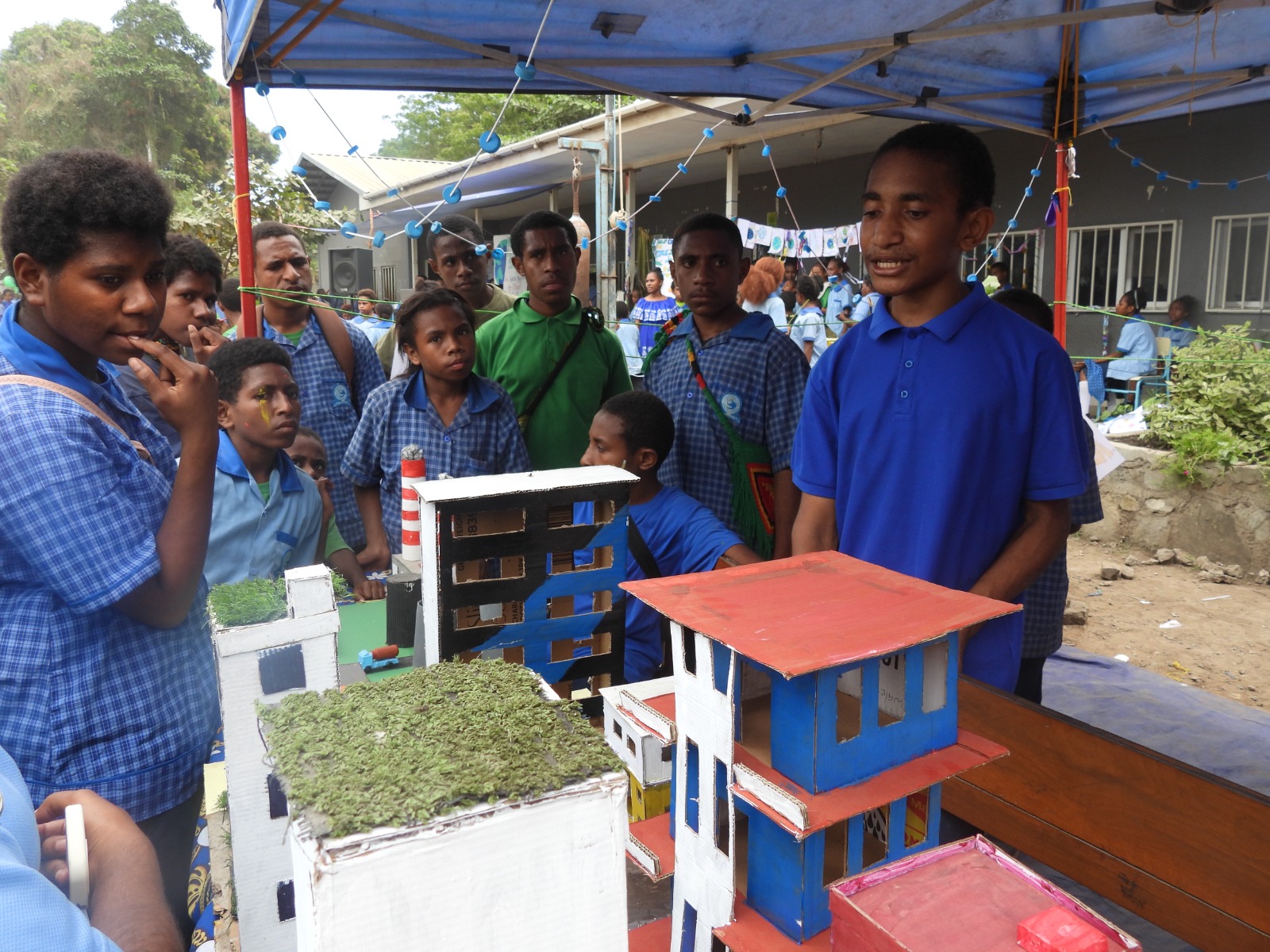
Despite having no formal science laboratory and limited access to learning resources, Grade 7 students at the Philip Aravure Primay School in Gerehu Stage 3, Port Moresby, successfully staged an impressive mini science and social fair, showcasing innovative projects on climate change and environmental sustainability.
The exhibition, held on Friday, 5th June, in observance of the World Environment Day, featured creative models and displays exploring the causes and effects of climate change, as well as practical solutions that communities can adopt to reduce environmental impacts.
Among the students presenting was 14-year-old Stalon Kaum, who explained that the project was specifically designed to educate parents, visitors, and fellow peers about the environmental challenges facing the world today.
“The students are trying to bring across some ideas and ways we can prevent or limit the effects of climate change,” Kaum said.
What made the exhibition particularly remarkable was that many of the displays were created using recycled and discarded materials collected by students themselves.
Without the benefit of a science laboratory or even a school library, the students relied on creativity, determination, and guidance from their teachers to bring their ideas to life.
“Our school does not have a library, and we do not have a science lab. When projects like this happen, our teachers encourage us to read and use whatever resources available to build our models.”
The result was a colourful and educational showcase that demonstrated both scientific understanding and originality.
Students proudly presented models promoting renewable energy solutions such as windmills and water turbines to highlight alternatives to fossil fuels and emphasize the importance of sustainable development.
Kaum noted that the experience allowed students to deepen their understanding of these scientific concepts by explaining their projects to the public.
“When you explain something to someone else, your understanding becomes clearer and you are in a better position to put what you have learned into practice.”
According to the teaching staff, the project was aimed at exposing students to higher-level scientific thinking at an early age while encouraging interest in science, technology, engineering, and mathematics (STEM) subjects.
Although the school’s resources are limited, the quality of the projects demonstrated that students could achieve impressive outcomes when given the opportunity and encouragement to learn through practical activities.
The mini science and social science fair not only highlighted the students’ knowledge of climate change, but also showcased their determination, creativity and passion for science, proving that a lack of facilities is no barrier to innovation and learning.