

What began as a training programme under the European Union-funded STREIT PNG initiative has evolved into a lasting community-driven movement in Wosera-Gawi District, where families are learning to plan together, manage income more effectively, and make decisions that benefit entire households.
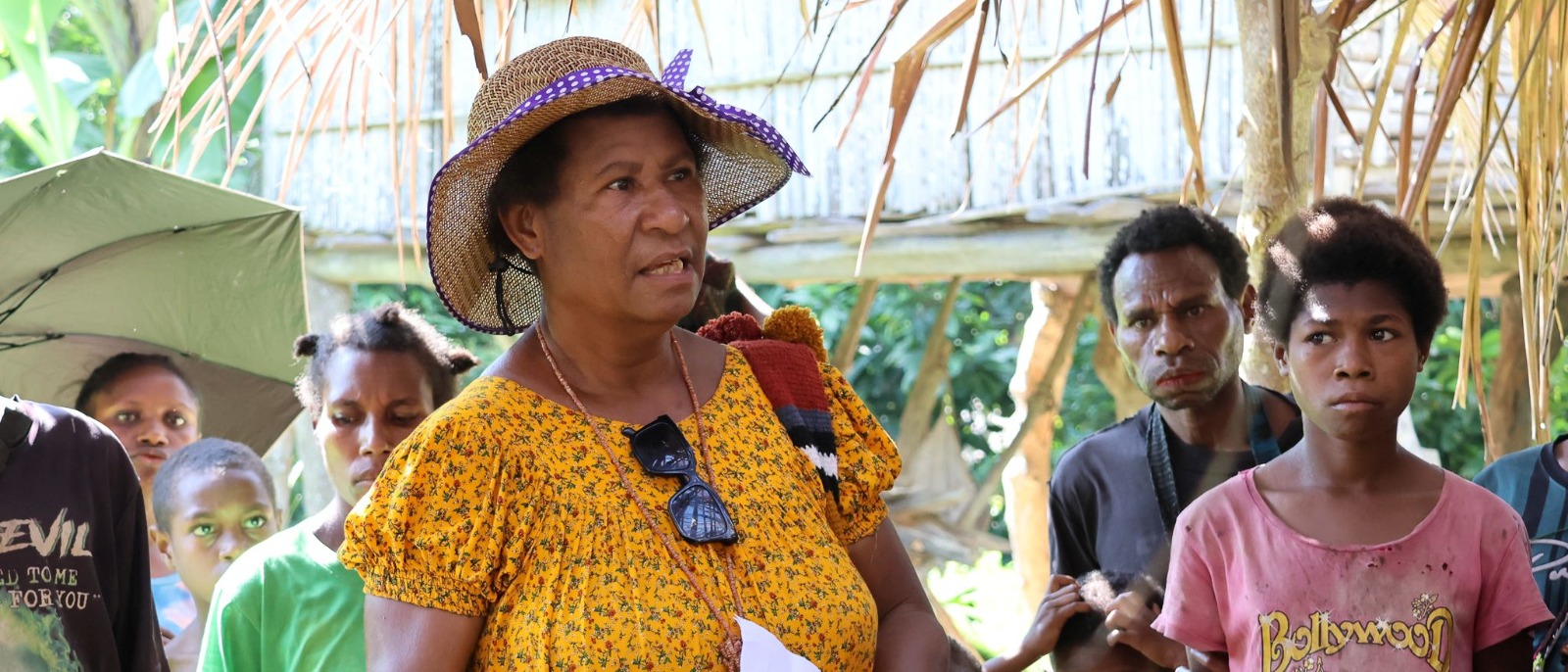
At the centre of this transformation is Angela Gossiba, Food Security Officer and Caretaker District Agriculture Coordinator for Wosera-Gawi, whose work is helping farmers strengthen not only their agricultural practices but also their family and community livelihoods.
During a recent cocoa budding training in Yembiyembi, a remote community in Gawi LLG, an elderly farmer reflected on the value of the Gender Action Learning System (GALS) training. After learning how families can plan and make decisions together using simple visual tools, he told fellow participants he wished he had received such guidance when he was younger. Although he could not turn back time, he said he would pass the knowledge on to his son so the next generation could benefit.
For Angela, stories like this are evidence of the programme's success.
Having served in the provincial agriculture service since 2007 and in Wosera-Gawi since 2016, Angela's role regularly takes her into some of East Sepik's most remote communities.
“Being a woman doing agriculture work is very tough,” she said. “You have to travel to very remote places, often on foot. But I have enjoyed the challenges. I have walked throughout the district and stayed with farming families in their villages.”
Through years of fieldwork, Angela observed a recurring challenge: women contribute significantly to food production yet often have limited access to training, resources, finance and decision-making opportunities. Young people face similar barriers.
To help address these issues, the EU-STREIT PNG Programme trained Angela as a Gender Coach, one of approximately 70 government officers and lead farmers equipped to deliver GALS across East and West Sepik provinces.
The approach uses drawings and visual planning tools rather than written documents, making it easier for rural families to identify goals, map out pathways to achieve them and discuss household responsibilities.
“Our people in the villages may not be able to prepare written project plans, but through drawings they are able to understand and participate,” Angela explained.

The training has produced tangible results across the district.
In Blamda, North Wosera, Angela combined cocoa extension services with household planning activities. She established a certified budwood garden for cocoa pod borer-tolerant seedlings, which now supplies planting materials to more than ten communities. Farmers have also gained skills in financial management and entrepreneurship, with many opening bank accounts and operating small cocoa businesses.
Beyond farming, the programme has influenced how families make decisions.
Angela recalls the experience of the Wani family, where household decisions were once made solely by the father.
“Before the training, the father made all the decisions without involving his wife or children,” she said. “After participating in GALS, he realised the importance of including the whole family in planning and decision-making.”
Another success story comes from Burui village, where farmer Nereus Saun and his wife Jaqueline Sakat used the GALS planning tools to achieve their education goals. After jointly deciding to invest their cocoa earnings into a fermentary to improve returns from dry bean sales, the couple generated enough income to fund Nereus' university studies. In 2026, he enrolled in a Bachelor programme at the University of Goroka.
Angela has also applied the lessons within her own family. After receiving GALS training in 2024, she guided her children through the Vision Journey planning process, helping them establish an inland fish farming project. The family later expanded into poultry production and cocoa development.
A key reason for the programme's ongoing impact is Angela's commitment to sharing the knowledge. She has trained around 20 Community Gender Advocates across the district's four local-level governments, enabling support to reach communities she cannot visit herself.
Among them is Julie Kleniaka, who leads the Wingum Women's Group in Patiko village, and Jude Wapi of Baluwe in the Chambri Lakes area, whose community used proceeds from cocoa seedling sales to construct an early childhood classroom completed in 2024.
Angela believes empowering local trainers and government officers is essential for long-term sustainability.
“Government officers and local trainers are permanently based in the communities and are in the best position to continue these activities while mentoring others,” she said.
Looking ahead, Angela is advocating for the establishment of dedicated gender desks within provincial and district agriculture offices. Speaking during regional consultations on the National Women and Youth in Agriculture Policy in Wewak, she proposed formally funded positions that would help women and youth farmers access extension services, markets, banking opportunities and financial support.
Despite the progress, Angela acknowledges significant challenges remain, including illiteracy, limited access to land and credit, insufficient business skills and law-and-order issues that often restrict women's mobility.
Nevertheless, she says the most encouraging change has been the growing confidence among women.
“Many women were afraid to stand in front of people or speak publicly,” she said. “They lacked confidence and often felt pushed aside. Now they know they have a place and a voice.”
In recognition of her work, Angela was named the EU-STREIT PNG Programme Champion for the Greater Sepik Region in 2024. Yet she views the achievement not as the end of a project, but as part of her everyday responsibility.
“It has already become part of me,” she said. “I now incorporate these approaches into every extension activity I conduct.”
As she continues travelling to remote villages throughout Wosera-Gawi, Angela remains motivated by the people she serves.
“There are people out there who need me,” she said. “That is what keeps me going.”
Her story reflects the broader legacy of the EU-STREIT PNG Programme, which has strengthened the skills of government officers across multiple sectors, enabling them to continue delivering lasting benefits to their communities long after the programme's direct interventions.