

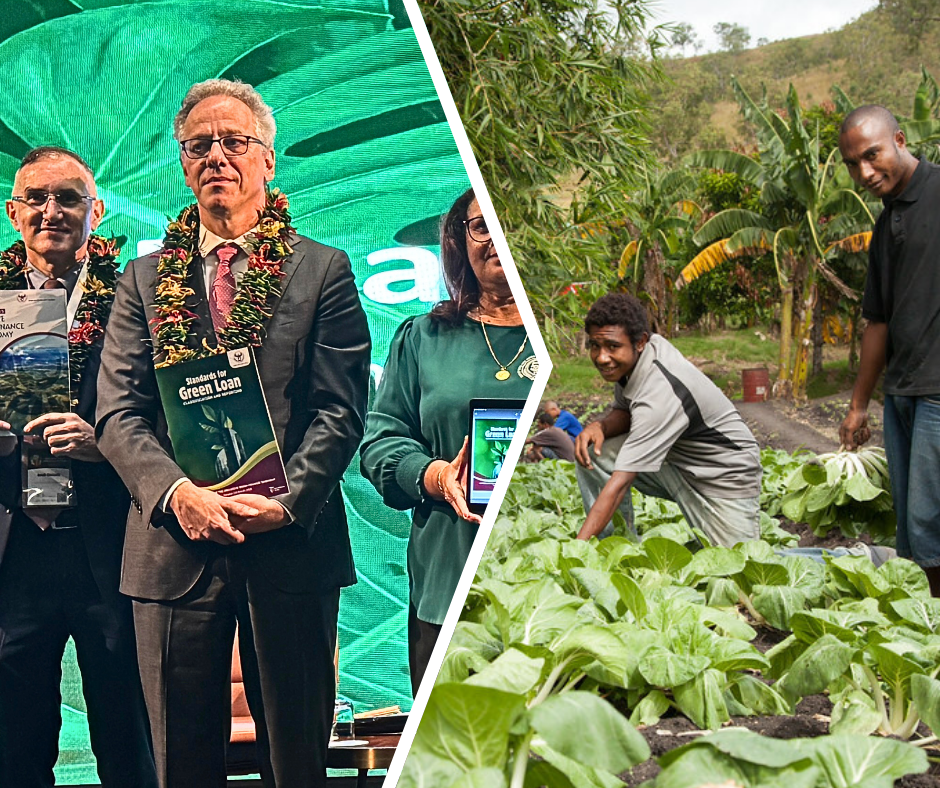
World Bank Division Director for Papua New Guinea (PNG) and Solomon Islands, Han Fraeters, says agriculture must become a key driver of PNG’s long-term economic transformation if the country hopes to achieve sustainable growth and middle-income status.
Speaking during Panel One of the recently held 2026 Green Finance Summit, Fraeters said the World Bank is now integrating sustainability into every aspect of its operations as part of its global mission to create a world free of poverty on a liveable planet.
“The phrase ‘liveable planet’ is now a core part of our mission,” Fraeters said.
“That means every decision we make whether it involves financing a project, providing technical assistance, supporting a program, or building partnerships is now assessed through a sustainability lens.”
Fraeters explained that the World Bank Group has changed the way it operates globally, bringing together the World Bank, IFC and MIGA into a more coordinated structure that combines public and private sector financing.
He said governments alone can no longer finance development at the scale required, making private investment increasingly important.
“One of the reasons for this shift is that public sector financing around the world is declining,” he stated.
“As a result, we now recognize that public sector financing and private sector financing must work together.”
Fraeters used agriculture as a key example of how this new model is being applied in PNG.
He said agriculture remains one of the country’s most important sectors but continues to struggle with limited access to finance because banks view agricultural lending as high-risk.
“However, we know that agriculture is essential to Papua New Guinea’s future development,” Fraeters said.
“If Papua New Guinea is to become a middle-income country and achieve the goals outlined in its development plans, the agriculture sector must transform.”
Fraeters said the World Bank Group is supporting projects such as the Agriculture Commercialization and Diversification Project to help smallholder farmers improve productivity, strengthen skills and produce higher-quality products.
At the same time, the International Finance Corporation is working with agribusinesses, processors and commercial banks to improve access to financing and encourage greater private investment into agriculture.
Fraeters said one of the major challenges remains the reluctance of banks to finance agricultural entrepreneurs.
“To address this, we are developing risk-sharing facilities,” he explained.
“Under these arrangements, international organizations like the World Bank Group would share part of the financial risk with commercial banks.”
He said this would reduce pressure on banks and make agricultural lending more viable.
Fraeters also stressed the importance of transport infrastructure, saying roads and transport systems are essential if agricultural products are to reach markets and ports efficiently.
“This integrated model is what we call the ‘Agri-Connect Initiative,’” he said.
Fraeters said partnerships with institutions such as the Asian Development Bank are also aimed at creating a more coordinated agriculture development platform for PNG.
Beyond agriculture, Fraeters also highlighted the importance of economic governance, foreign exchange stability, banking reforms and green finance frameworks in strengthening PNG’s investment environment.
“Papua New Guinea must become recognized as a place where it is possible and safe to do business,” he said.
“That transformation requires coordinated work across governance, finance, agriculture, infrastructure, and sustainability.”