

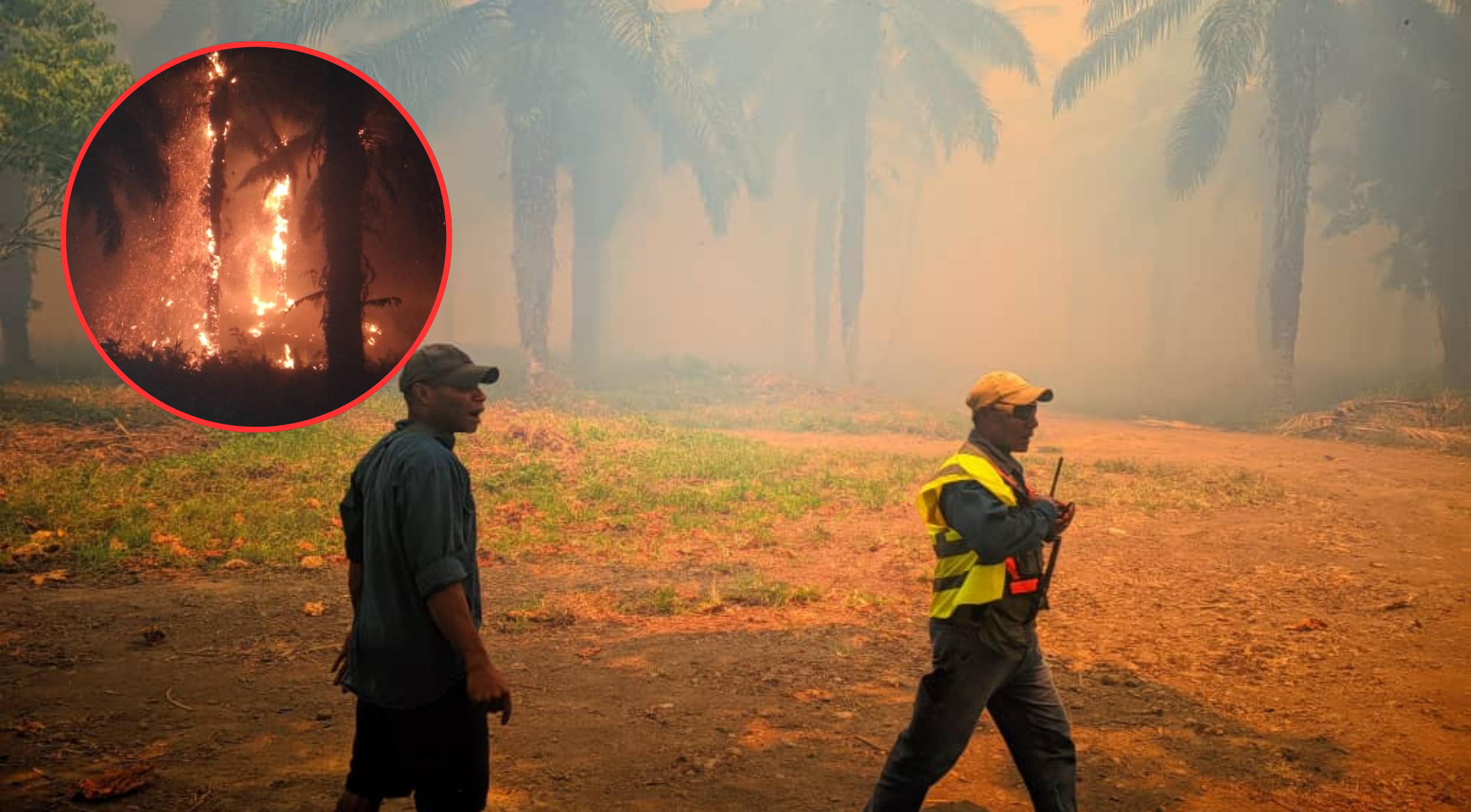
West New Britain (WNB) Province has emerged as one of the hardest-hit regions in Papua New Guinea as a severe El Niño event continues to devastate livelihoods and inflict catastrophic damage on the environment.
Widespread wild bushfires have erupted across the province, destroying natural vegetation, vital food gardens, and commercial oil palm and coconut plantations. The fires have swept across the mountain ranges in the Hoskins area, posing an immediate threat to local communities, native wildlife, and ecosystems.
West New Britain Disaster Coordinator, Mr. Herman Volele, reported from Hoskins that the current El Niño conditions are unprecedented.
“The effects are comparable to a volcanic disaster,” Mr. Volele stated. “The conditions are extreme—the land is entirely parched, creating a severe fire hazard. Intense heat and wildfires are everywhere.”
The latest crisis occurred yesterday, Friday, October 3, 2026, near Hoskins Airport. A bushfire ignited and rapidly consumed approximately 10 hectares of coconut palms and vegetation within minutes.
“There was no way to control or contain the blaze,” Volele recalled. “We stood helpless, watching it devour everything in its path. Thick smoke and heavy ash have created severe health risks for nearby communities and are threatening airspace safety, impacting aircraft operations at the terminal.”
On Thursday, the provincial Disaster Office met with representatives from New Britain Palm Oil Limited (NBPOL), to assess the unfolding crisis. Reports confirm that wildfires have destroyed vast swathes of oil palm plantations and smallholder blocks stretching across Talasea, Kandrian-Gloucester, Hoskins, Bialla, and Nakanai.
Industry representatives have labeled the crisis as a very high-risk situation that will severely impact future palm oil production.
Driven by a relentless heatwave and strong south-easterly winds, officials warn that if El Niño conditions persist for another six to eight months, the province faces complete environmental devastation.
“Temperatures have soared to between 34 and 35 degrees Celsius,” Volele noted. “This level of heat is pushing the limits of survival for the environment, wildlife, and human populations.”
Efforts to combat the blazes are being severely hindered by localized resource constraints. The provincial fire service is overwhelmed, operating with only two deteriorating fire trucks. Given the sheer scale and frequency of the outbreaks across the province, emergency services are stretched to their limits and unable to manage the widespread disasters.
Mr. Volele issued an urgent appeal for national assistance: “We genuinely need immediate government intervention. We are calling for the release of the promised K2.5 million El Niño relief funds to support affected lives across all districts, and to reinforce our fire and disaster services as we work to combat this crisis and save lives.”