
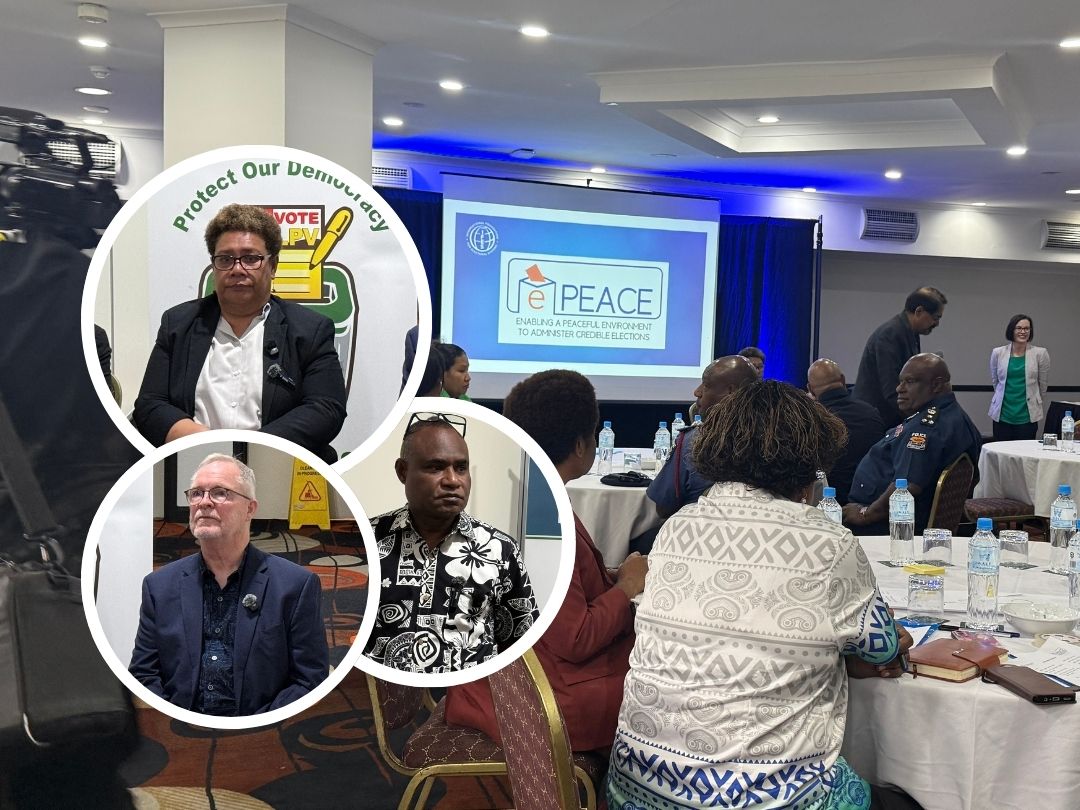
Preparations for the 2027 National General Election (NGE) took a significant step forward today with the commencement of a three-day Joint Election Security Workshop involving the Papua New Guinea Electoral Commission (PNGEC) and the Royal Papua New Guinea Constabulary (RPNGC) at the Holiday Inn, Port Moresby.
The workshop, facilitated by the International Foundation for Electoral Systems (IFES) under its Enabling a Peaceful Environment to Administer Credible Elections (E-PEACE) program, aims to strengthen coordination between electoral officials and police to ensure next year's National General Election is safe, credible and trusted by the people of Papua New Guinea.
The workshop brings together Provincial Police Commanders (PPCs), Assistant Commissioners of Police (ACPs), and officers from the PNG Electoral Commission to improve operational planning and coordination before, during and after the election period.
Opening the workshop was Acting Electoral Commissioner Ms. Margaret Vagi, who welcomed the senior police officers and emphasized that election security cannot be achieved by a single institution.
"Election security is not the responsibility of one institution alone. No single agency can deliver a secure election. It depends on close, continuous collaboration between the PNG Electoral Commission and the police at every level. When we work together, we are stronger. When we operate separately, gaps emerge that can undermine the entire process."
Supporting the Acting Electoral Commissioner's remarks, Acting Assistant Commissioner for Border Security, Steven Francis, said the workshop provides an important opportunity for both agencies to strengthen their operational partnership.
"There must be collaboration between the two agencies, so this workshop itself is to ensure the fine-tuning of our security preparation. We all know that the Electoral Commission is the mandated organization that takes the lead in the electoral process, while for us police, our main role is to provide security and make sure the environment is conducive for the election to proceed."
He said bringing together Assistant Commissioners and Provincial Police Commanders would strengthen cooperation at provincial and district levels.
"One thing is to understand who the Electoral Manager is on the ground and who the Provincial Police Commander is on the ground so that this collaboration at the local level, district level and provincial level is something we should have done a long time ago. Workshops like this pave the way."
The workshop highlighted that while the Electoral Commission and the Royal Papua New Guinea Constabulary have separate statutory responsibilities, both institutions are closely interconnected and must operate as one coordinated system.
Under this arrangement, the Electoral Commission administers the election process in accordance with the law, while police provide the security and law and order necessary to ensure elections are conducted safely and without disruption.
IFES Senior Country Director Michael Yard, who has supported elections in more than 50 countries, shared international experiences and stressed the importance of early security planning.
"I know that in some countries security is not a major issue. There is very little violence after elections, but unfortunately that has become rarer. Over the last decade I have seen politicians never accepting the outcome of elections and, by failing to accept the results, inciting supporters and political parties to object, sometimes causing followers to act violently. That is why planning is critically important."
The Joint Election Security Workshop will run from July 1 to July 3, bringing together senior police commanders and Electoral Commission officials to strengthen inter-agency coordination ahead of the 2027 National General Election.