


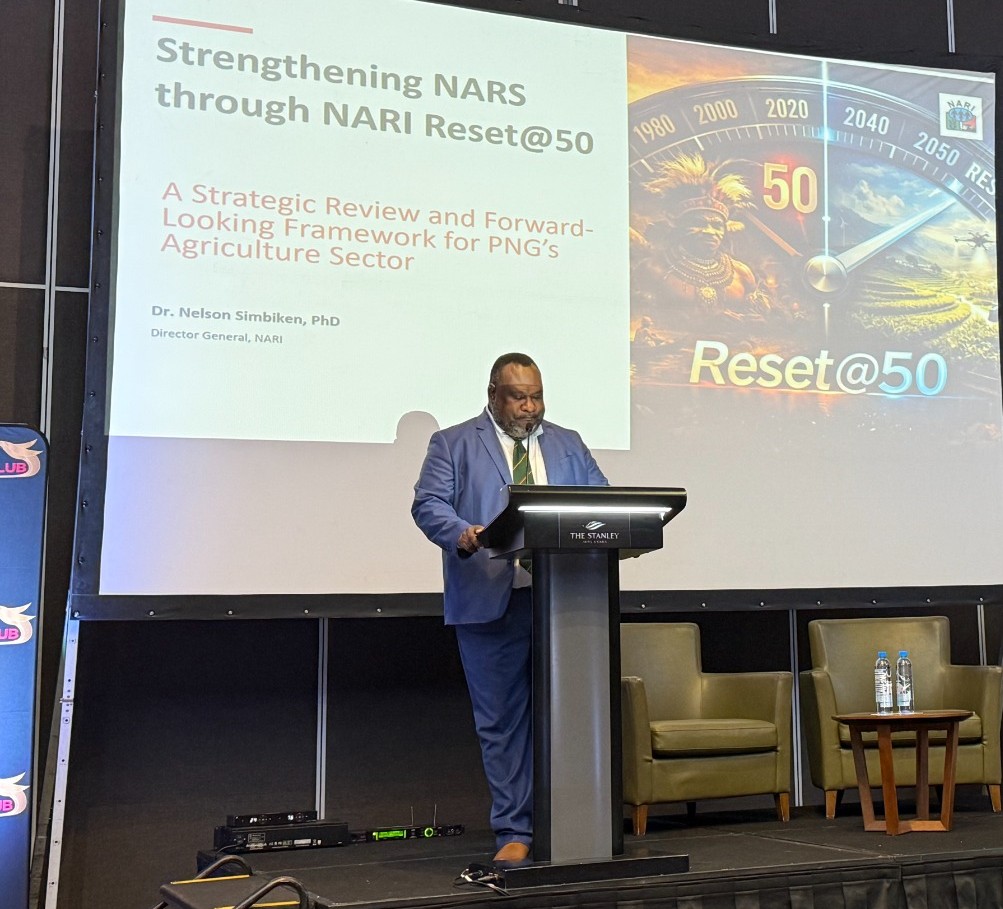
Agricultural research must play a central role in transforming Papua New Guinea’s farming sector from subsistence-based production to a commercially competitive industry according to National Agricultural Research Institute Director General Dr Nelson Simbiken.
Dr Simbiken said research is not an academic exercise but a practical necessity that directly addresses the challenges farmers face from production to market access.
He said strong research systems are critical for improving crop productivity, reducing post-harvest losses, increasing value addition and ensuring agricultural products meet quality standards required for domestic and export markets.
Established in 1996, NARI’s mandate is to enhance productivity, efficiency, stability and sustainability within the smallholder agriculture sector, which supports the majority of Papua New Guinea’s rural population.
Dr Simbiken said over the past three decades, NARI has built a strong technical foundation, releasing more than 27 improved crop varieties including taro, rice and banana varieties that are now being adopted by farmers and commercialized.
He said these innovations have contributed to improved food security and better livelihoods for rural communities across the country.
However, Dr Simbiken acknowledged that having technology at the farm gate is only the first step, and that significant gaps remain in post-harvest processing, value addition and market access.
“The challenge now is to transform these innovations into high-value products that reach the kitchen table and the global market,” he said.
To address this gap, Dr Simbiken stressed the importance of public-private partnerships, saying the private sector has a key role to play in processing, logistics and market development.
He also highlighted the need for stronger government support, describing agricultural research as a public good that requires state intervention to de-risk innovation and encourage private sector investment.
Dr Simbiken said NARI is advocating for the establishment of a national agricultural innovation grant scheme, which would provide targeted funding to support research, development and commercialization.
He said strengthening research investment is essential if Papua New Guinea is to achieve long-term goals under the National Agriculture Sector Plan, including food security, job creation and the transformation of subsistence farmers into tax-paying commercial producers.
Dr Simbiken said Reset 50 represents a long-term commitment to turning research into tangible economic outcomes and building a resilient and prosperous future for rural communities.