

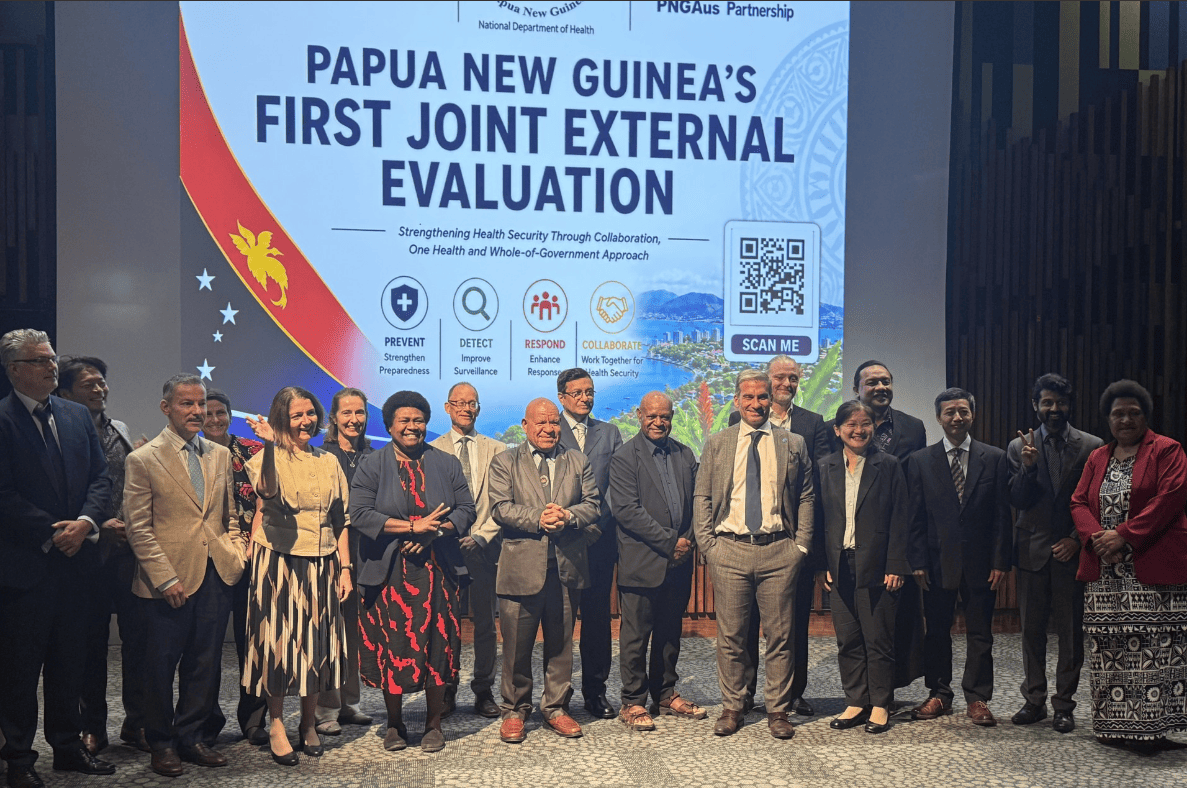
Papua New Guinea has completed its first-ever Joint External Evaluation (JEE), marking a major milestone in the country’s efforts to strengthen national preparedness and response to public health emergencies.
Held from August 24th to the 28th, 2026, the five-day evaluation brought together government ministers, technical directors, health security experts, and international evaluators to assess PNG’s capacity to prevent, detect and respond to public health threats under the International Health Regulations (IHR 2005).
The evaluation was conducted in collaboration with the World Health Organization (WHO) and involved experts from health, agriculture, environment, security, finance, and other key sectors.
JEE had provided PNG with a shared understanding of the country’s health security strengths and gaps.
The recommendations would guide the development of a national health security action plan and support continued improvements in emergency preparedness and response.
The findings would now be used to develop a prioritized and fully costed National Action Plan for health security and also provide the government with a clear basis for deciding where further investment is required and will support our development partners to align their assistance with PNG’s priorities.
The evaluation brought together national decisionmakers and international experts, including WHO Regional Emergency Director for the Western Pacific Dr. Gina Samaan and Food and Agriculture Organization (FAO) Food Safety Officer Dr. Jorge Pinto Ferreira.
Regional expertise was also provided by organizations including the Asian Development Bank, Tonga’s Ministry of Health, New Zealand Defence Force, Australian Centre for Disease Control, and Singapore’s National Centre for Infectious Diseases.
WHO Representative for PNG Dr Rajendra Prasad Hubraj Yadav said the value of the evaluation would ultimately be measured by the actions taken to address identified gaps.
“WHO would continue supporting the Government and partners to turn the recommendations into practical action from national systems through to provinces, districts, and frontline health services.”
The JEE identified several priority areas for strengthening PNG’s health security, including:
Establishing or designating a National IHR Authority to coordinate implementation of the International Health Regulations.
Strengthening the role of the IHR National Focal Point.
Using Ward Development Committees to strengthen Village Health Assistant functions, including emergency preparedness and response.
Developing and implementing a five-year National Action Plan for Health Security.
Enacting the revised Public Health Act and developing a funded implementation plan.
Increasing investment in essential health services and Water, Sanitation and Hygiene (WASH) at primary care levels.
Implementing the National Immunization Strategy 2026–2030.
Improving timely information sharing across One Health sectors.
Establishing a scheduled, multi-year programme of national and multisectoral simulation exercises.
The JEE was supported through WHO’s partnership with the Australian Government Department of Foreign Affairs and Trade (DFAT).
The evaluation is expected to provide an evidence base for Government and development partners to better target investments and strengthen PNG’s health security systems.
The focus now shifts from evaluation to implementation, with the Government expected to use the findings to guide investment and action over the coming years.