

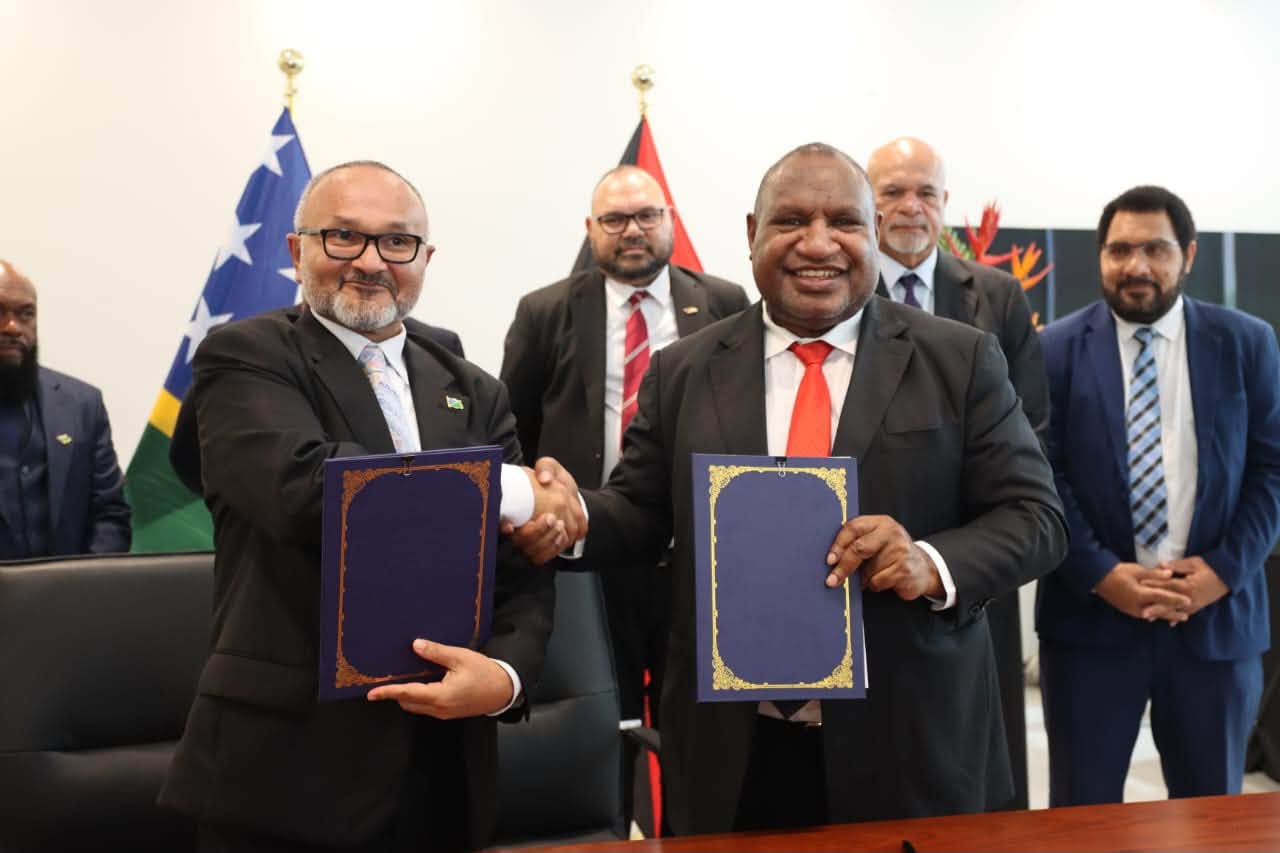
Prime Minister James Marape has offered Papua New Guinea’s extensive experience in mining policy to assist the Solomon Islands in developing a modern resource regime.
The initiative aims to maximize local benefits while keeping the sector attractive to investors.
Prime Minister Marape welcomed an invitation from Solomon Islands Prime Minister Matthew Wale for PNG mining companies to participate directly in developing mineral projects in the neighbouring nation.
During bilateral discussions in Port Moresby, Prime Minister Marape emphasized that PNG has learned valuable lessons over decades of resource development- encompassing both successes and critical mistakes.
“As you develop your mining laws, it is important to get them right from the beginning,” Prime Minister Marape said. “Papua New Guinea is still refining its own resource laws, but we have accumulated decades of experience.”
“We are prepared to send our resource lawyers and technical experts to work with your team so that together we can develop policies that deliver long-term benefits for our people.”
Both nations sit on the Pacific Ring of Fire, giving them immense potential to build prosperous economies from natural resources.
PNG’s current policy framework seeks to ensure the State receives at least 55 percent of the total economic benefits from major projects through taxes, royalties, and equity.
“Our objective is simple. Investors must make a reasonable return because they bring capital, technology and expertise.”
“At the same time, the country that owns the resources must also receive a fair and equitable share of the benefits.”
He stressed that equity represents direct ownership and decision-making power, which is fundamentally different from taxation.
“Tax is simply what every company pays for doing business in our country. Equity represents ownership.”
“When the State and landowners hold equity, they sit at the decision-making table and participate directly in the long-term value created by the project.”
Drawing on national history, Prime Minister Marape noted that PNG’s resource reforms were heavily shaped by the Bougainville crisis at the Panguna Mine, where landowners initially received little direct ownership.
“The Bougainville crisis remains a lasting reminder of what can happen when resource development is not perceived as fair by the people who own the land.”
“Our biggest lesson is this: if you do not get the relationship with customary landowners right, the project will ultimately fail. Landowners must be central to any resource development policy.”
Because resources in both nations are located on customary land, Prime Minister Marape highlighted the need to move away from legacy colonial agreements.
“We carry the burden of history. Many of our older mining agreements reflected another era, and today we continue working to secure fairer outcomes for Papua New Guinea.”
As a modern success story, he cited the recent reopening of the Porgera Gold Mine, where PNG interests negotiated a 51 percent stake. Prime Minister Wale expressed his intention to pursue a similar equity model in the Solomon Islands.
“I commend Prime Minister Wale for embracing a vision that ensures the people of Solomon Islands receive a greater share of the wealth generated from their own natural resources,” Prime Minister Marape said.
“He has invited Papua New Guinea mining companies to partner in the development of mining projects in Solomon Islands under a benefit-sharing model where Solomon Islands interests would retain 51 per cent equity while the investor holds 49 per cent, similar to the approach we negotiated at Porgera.”
This partnership signals PNG’s emergence as a respected regional mining nation.
State-owned entities Kumul Minerals Holdings Limited and Ok Tedi Mining Limited have already been tasked to explore these new opportunities.
Prime Minister Marape also emphasized the importance of local content policies to ensure mining operations support domestic businesses and employment.
“A successful mining industry is not measured only by taxes and royalties. It is also measured by how much business activity, employment, procurement and value creation remain within the country.”
“Mining operations spend millions of dollars every month on goods and services. The more local businesses that supply those goods and services, the more wealth remains circulating in the national economy.”
While the Solomon Islands has a unique greenfield opportunity to establish these policies early, Prime Minister Marape cautioned against creating overly harsh fiscal regimes that might deter investors.
“Resource investors are not charities- they invest where projects remain commercially viable. You cannot expect investors to pay premium taxes while also surrendering excessive equity.”
“Governments must strike the right balance, so investors continue to achieve internationally competitive returns while resource-owning countries receive a substantially greater share of the overall benefits.”
Ultimately, the collaboration aims to build a stronger Pacific resource economy.
“Our experience has taught us many valuable lessons. If those lessons can help the Solomon Islands avoid the mistakes we made and build a stronger resource economy from the beginning, while at the same time creating opportunities for Papua New Guinea companies to invest across the Pacific, then our partnership will benefit both our nations,” Prime Minister Marape concluded.