

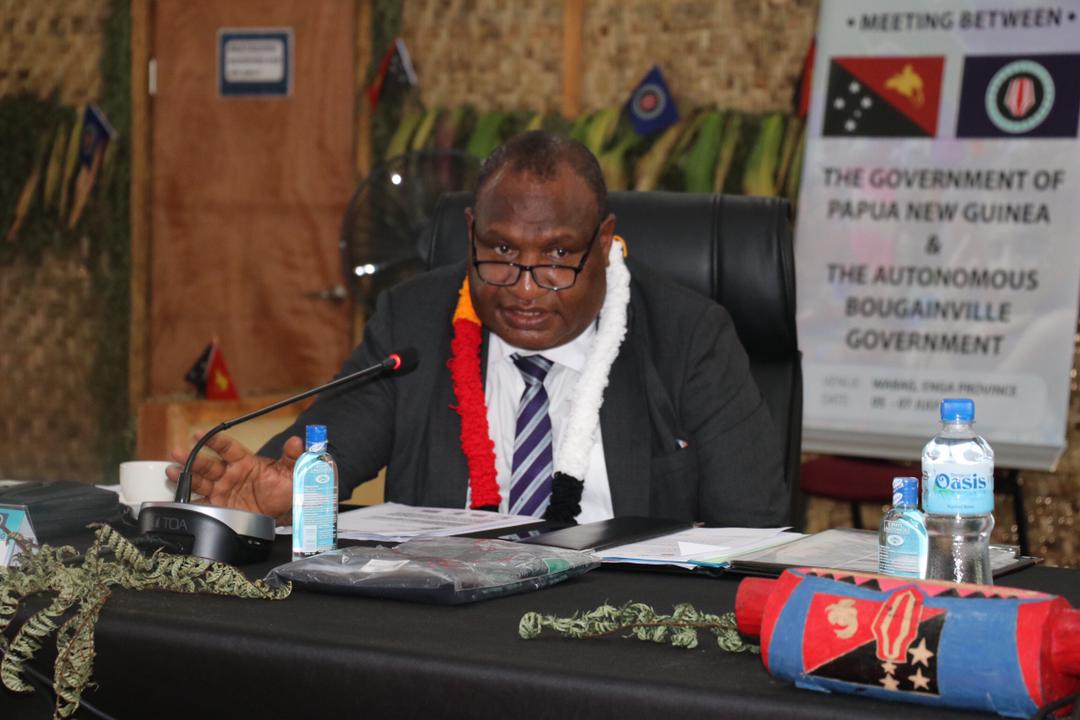
 PM Marape, Acting UN Resident Coordinator Dirk Wagener and Bougainville President Ishmael Toroama during the JSB meeting in Wabag.[/caption]
In noting the results of the referendum, the Prime Minister said that he considers it his role to direct the work to ensure that the next steps are complied with.
“As Prime Minister, my role now is to lead our national consultation team and provide the direction that is needed to seek a long-term political settlement by ensuring that the next steps are taken appropriately and carefully.”
He expressed disappointment that while the priority was highlighted in Kokopo, the focus was clearly only on the road map.
“In Kokopo, we directed the officials to deal with four issues, namely to consult on the definition and process of giving effect to the result of the referendum. They were to identify the constitutional issues relating to the referendum results and the tabling of the outcomes to Parliament, develop a road map on Post Referendum Consultations, and fully implement the Sharp Agreement.
“I note with concern that the matter and process of giving effect to the results of the referendum, and the identification of the constitutional issues relating to the tabling of the result of the referendum and the consultation outcomes have not been dealt with in sufficient detail.”
He urged that both sides recognize that these are two important issues to consult on.
“Once the motion goes before Parliament, it becomes the property of Parliament. I want to note therefore that this will dictate the Road Map in a significant way. Let us deal with these two issues upfront, before we get too far down the track.”
Meanwhile, PM Marape also noted the critical need to consult the rest of Papua New Guinea on this matter.
“I said in Kokopo, that this process cannot be rushed. The future of our nation is at stake. This process is the single most important agenda any government is faced with. Far bigger than COVID-19 or our economic challenges. All our people around the rest of the country must be consulted.”
“Our Constitution and the Independent State of Papua New Guinea was established on the back of wide national consultations. Therefore, we must give our people an opportunity to give their views on the outcome of the Bougainville Referendum before Parliament meets to consider the referendum results.”
He said that when the 111 members of our Parliament vote on their own conscience, it must be on the basis that their constituents have been consulted properly.
He noted strongly that Bougainville is a special consideration that all successive governments since the crisis have recognized.
“I continue to reiterate that we must be allowed to ring fence the rest of the country. Bougainville remains a special case. My job is to ensure that the rest of the country remains united.”
[caption id="attachment_11462" align="aligncenter" width="641"]
PM Marape, Acting UN Resident Coordinator Dirk Wagener and Bougainville President Ishmael Toroama during the JSB meeting in Wabag.[/caption]
In noting the results of the referendum, the Prime Minister said that he considers it his role to direct the work to ensure that the next steps are complied with.
“As Prime Minister, my role now is to lead our national consultation team and provide the direction that is needed to seek a long-term political settlement by ensuring that the next steps are taken appropriately and carefully.”
He expressed disappointment that while the priority was highlighted in Kokopo, the focus was clearly only on the road map.
“In Kokopo, we directed the officials to deal with four issues, namely to consult on the definition and process of giving effect to the result of the referendum. They were to identify the constitutional issues relating to the referendum results and the tabling of the outcomes to Parliament, develop a road map on Post Referendum Consultations, and fully implement the Sharp Agreement.
“I note with concern that the matter and process of giving effect to the results of the referendum, and the identification of the constitutional issues relating to the tabling of the result of the referendum and the consultation outcomes have not been dealt with in sufficient detail.”
He urged that both sides recognize that these are two important issues to consult on.
“Once the motion goes before Parliament, it becomes the property of Parliament. I want to note therefore that this will dictate the Road Map in a significant way. Let us deal with these two issues upfront, before we get too far down the track.”
Meanwhile, PM Marape also noted the critical need to consult the rest of Papua New Guinea on this matter.
“I said in Kokopo, that this process cannot be rushed. The future of our nation is at stake. This process is the single most important agenda any government is faced with. Far bigger than COVID-19 or our economic challenges. All our people around the rest of the country must be consulted.”
“Our Constitution and the Independent State of Papua New Guinea was established on the back of wide national consultations. Therefore, we must give our people an opportunity to give their views on the outcome of the Bougainville Referendum before Parliament meets to consider the referendum results.”
He said that when the 111 members of our Parliament vote on their own conscience, it must be on the basis that their constituents have been consulted properly.
He noted strongly that Bougainville is a special consideration that all successive governments since the crisis have recognized.
“I continue to reiterate that we must be allowed to ring fence the rest of the country. Bougainville remains a special case. My job is to ensure that the rest of the country remains united.”
[caption id="attachment_11462" align="aligncenter" width="641"] President Ishmael Toroama and PM James Marape[/caption]
He said that this process has been a long one but as it comes to the most important stages, we must all tread cautiously.
“Until such time Parliament takes a position and until such time the requisite amendments are effected on the national constitution to detach one part of our great country from ourselves, my government is committed to work closely with the Autonomous Region of Bougainville to seek out a long term political settlement.”
The Prime Minister said it was important that consultations and continued dialogue happen. By continuing to talk through the issues, whilst maintaining our focus and resolve to put in place the practical measures to transfer powers to the ABG, we can lay the foundations for Bougainville’s long-term economic future. That is what we must focus on, ensuring that we position Bougainville for success – to manage its own affairs, in the form of a final political settlement.
"Today, I would like us to look at these practical processes and steps, and to agree on a joint roadmap. The Road Map must inform the steps that we take to get to a final position where the Parliament can make an informed decision.”
The consultation consented that both sides should take all actions required to ensure that 11th Parliament makes a decision, and work towards an outcome no earlier than 2025 and within the years up to 2027.
President Ishmael Toroama and PM James Marape[/caption]
He said that this process has been a long one but as it comes to the most important stages, we must all tread cautiously.
“Until such time Parliament takes a position and until such time the requisite amendments are effected on the national constitution to detach one part of our great country from ourselves, my government is committed to work closely with the Autonomous Region of Bougainville to seek out a long term political settlement.”
The Prime Minister said it was important that consultations and continued dialogue happen. By continuing to talk through the issues, whilst maintaining our focus and resolve to put in place the practical measures to transfer powers to the ABG, we can lay the foundations for Bougainville’s long-term economic future. That is what we must focus on, ensuring that we position Bougainville for success – to manage its own affairs, in the form of a final political settlement.
"Today, I would like us to look at these practical processes and steps, and to agree on a joint roadmap. The Road Map must inform the steps that we take to get to a final position where the Parliament can make an informed decision.”
The consultation consented that both sides should take all actions required to ensure that 11th Parliament makes a decision, and work towards an outcome no earlier than 2025 and within the years up to 2027.