


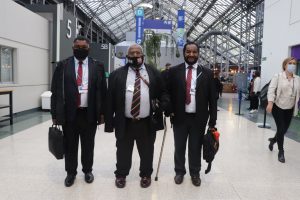
 “That has been spelt out in our National Determined Contribution, which we submitted on 18th December 2020, having been one of the first few countries in the world to do so,” Minister Mori said.
He said PNG now has all relevant enabling legislations to basically walk along that path.
“The biggest question now is, monetization of our efforts – how do we get compensated?
“We just simply can’t ban logging in PNG, as it is a $1 billion industry, where the industrialized world expects us to continue to be the carbon filters of the earth, when they are only good for talking but not being responsible for our climate predicaments,” Minister Mori said.
He said Papua New Guinea is a member of the global community so when we decide to do that, we know what the costs are, having done our part.
“We would like to see the industrialized world or the first world who are responsible for the emission of greenhouse gases, come up with financial and economic development assistance packages.
“So, if the UN or the industrialized countries wanted us to terminate logging in our country entirely, they would have to make up for the revenue we raise from that particularly industry, annually,” Minister Mori said.
He said for other members of the Coalition for Rainforest Nations (CfRN), I will also advocate on their behalf. They too must be compensated.
[caption id="attachment_16534" align="aligncenter" width="534"]
“That has been spelt out in our National Determined Contribution, which we submitted on 18th December 2020, having been one of the first few countries in the world to do so,” Minister Mori said.
He said PNG now has all relevant enabling legislations to basically walk along that path.
“The biggest question now is, monetization of our efforts – how do we get compensated?
“We just simply can’t ban logging in PNG, as it is a $1 billion industry, where the industrialized world expects us to continue to be the carbon filters of the earth, when they are only good for talking but not being responsible for our climate predicaments,” Minister Mori said.
He said Papua New Guinea is a member of the global community so when we decide to do that, we know what the costs are, having done our part.
“We would like to see the industrialized world or the first world who are responsible for the emission of greenhouse gases, come up with financial and economic development assistance packages.
“So, if the UN or the industrialized countries wanted us to terminate logging in our country entirely, they would have to make up for the revenue we raise from that particularly industry, annually,” Minister Mori said.
He said for other members of the Coalition for Rainforest Nations (CfRN), I will also advocate on their behalf. They too must be compensated.
[caption id="attachment_16534" align="aligncenter" width="534"] Minister Wera Mori in a pull aside meet with the British Prime Minister, Boris Johnson,[/caption]
“It is completely unfair that we are the victims of the climate problems we have not caused,” Minister Mori said.
He also had brief pull aside meetings with the British Prime Minister, Boris Johnson, and His Royal Highness Prince Charles, at the margins of the COP26 Leaders’ Summit, in Scotland.
Minister Wera Mori in a pull aside meet with the British Prime Minister, Boris Johnson,[/caption]
“It is completely unfair that we are the victims of the climate problems we have not caused,” Minister Mori said.
He also had brief pull aside meetings with the British Prime Minister, Boris Johnson, and His Royal Highness Prince Charles, at the margins of the COP26 Leaders’ Summit, in Scotland.