

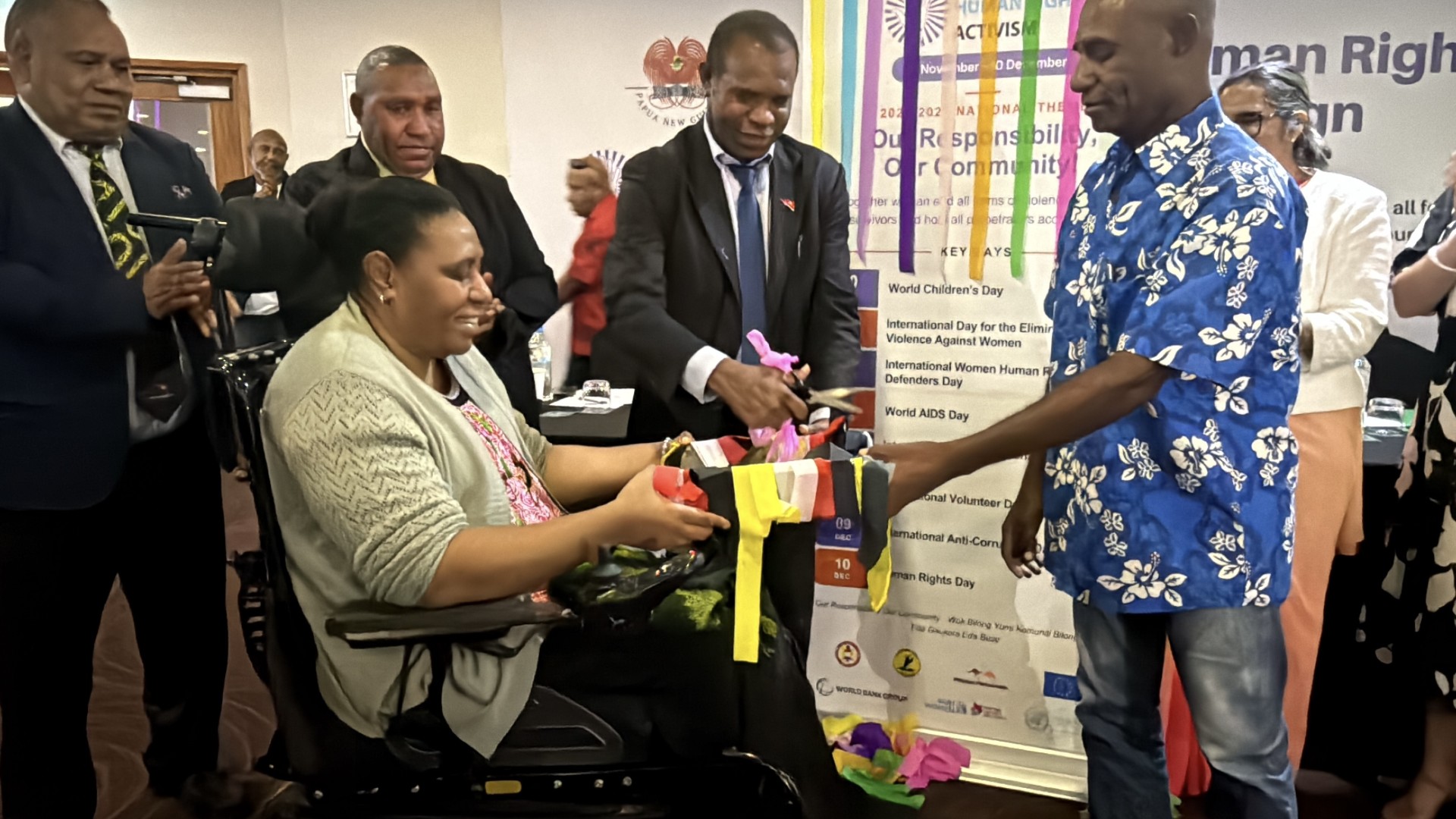
Community Development, Youth and Religion Minister Hon. Jason Peter is now calling for coordinated action to make the law’s protections real in the lives of people with disabilities at this time as Papua New Guinea begins implementing the National Disability Services Act 2025.
Speaking at the Act’s launch at Holiday Inn in Port Moresby on Friday, Peter said the occasion was more than a ceremony, it was an opportunity for the government and the nation to renew their commitment to human rights, equality, and an inclusive society.
“Disability inclusion is not charity. It is a matter of human rights, equality, dignity, and social justice,” he said.
Peter highlighted that people with disabilities continue to face discrimination and barriers to education, healthcare, employment, transport, public infrastructure and community participation. He stressed that they are equal citizens and contributors to their families, communities and the nation, but not passive recipients of assistance.
The Minister said the Act’s success would depend on collective commitment and effective implementation. He called on national and sub-national governments to incorporate disability inclusion into planning, budgeting, infrastructure development and service delivery.
Schools, hospitals, public facilities, transport systems and government services must become more accessible and responsive, he said. People with disabilities and their representative organizations must also be meaningfully included in decisions affecting their lives.
“Nothing about persons with disabilities should be decided without their meaningful participation,” Peter said, urging all sectors to help build a country where everyone can contribute and live with dignity.
The Minister placed the launch within a wider call to address violence, discrimination and social exclusion across Papua New Guinea. He said women and girls continue to experience sexual and gender-based violence, while children remain vulnerable to abuse, neglect and exploitation.
He cited a 2025 study by the National GBV Secretariat, which estimated that about 64 per cent of women experience intimate partner violence annually, affecting an estimated 3.4 million women. The study also estimated the annual economic cost of gender-based violence at about 6.2 per cent of the country’s gross domestic product.
The Minister stated that the national response system requires strengthening and he noted that only five of the country’s 22 provinces have functional gender-based violence secretariats, while around 40 family support centres serve the nation.
Peter also raised concerns about women’s limited representation in leadership, saying three women currently serve in the 118-member National Parliament. He said these challenges require urgent, coordinated and sustained action.
“Human rights must not remain abstract concepts or policy statements. They must be reflected in how we treat one another, how we deliver services and how we govern our country,” he added.
Peter pointed to several laws and policies intended to protect people and promote equality, including the Family Protection Amendment Act 2022, the Lukautim Pikinini Act 2015, the National Disability Service Act 2025, and the Community Development Act 2025. He also cited the National GBV Strategy 2026–2035, the National Human Rights Policy 2020, and other national strategies and policies.
Papua New Guinea is also a party to international human rights conventions, including the Convention on the Elimination of All Forms of Discrimination Against Women, the Convention on the Rights of the Child and the Convention on the Rights of Persons with Disabilities.
But the Minister has cautioned that laws and policies alone were not enough. He said the priority now must be to strengthen institutions, improve coordination, allocate adequate funding and extend services across provinces, districts and communities.
Progress should be measured not only by the number of policies adopted, but by improvements in people’s lives and the safety and inclusion of their communities. Minister Peter affirmed that his ministry and department would work with government agencies, provincial and district administrations, development partners, churches, civil society and organizations of people with disabilities to advance implementation of the Act.
He urged government at every level to take ownership of disability inclusion and urged the wider community to help prevent violence, protect survivors, and hold perpetrators accountable.
“Together we can build a Papua New Guinea where every person, regardless of ability, has the opportunity to participate, contribute and live with dignity,” Minister Peter concluded.