

POSTS BY AUTHOR
Emmanuel MAIPE
 BSP FINANCE ANNOUNCES NEW DEAL ON VEHICLE LOAN
The recent launching and introduction of the new Nissan Navara PRO 4X vehicle to Papua New Guinea (PNG) by Boroko Motors and the parent company - WR Carpenters also saw a new deal for vehicle loans announced by BSP Finance to cater for customers wanting to purchase the vehicle.
BSP Finance Head of Lending Mr. David Managa announced the new deal saying that this should make things a bit easier for customers interested in owning one for themselves.
BSP Financial Group and WR Carpenters have a very long relationship history on PNG and also in the pacific and for BSP Finance a subsidiary of the BSP Group, we also share a very strong relationship with Boroko Motors, said Mr. Managa.
In support of Boroko Motors with the launch of the new Nissan Navara, BSP Finance will support by giving customers special discount on the interest rate and also a fuel card of K500 from Puma with any approved financing from our customer vehicle loan.
Mr. Managa added that this launching also coincided with the recent changes to BSP Finance Consumer Vehicle Loan product, which is designed similar to a personal loan.
He said customers interested in this special offer can always contact BSP Finance for more detail or visit their website.
Meanwhile, the new Nissan Navara PRO 4X was launched on Wednesday 30th March in Port Moresby and should be available at all Boroko Motors branches nationwide.
Boroko Motors is the main distributor of Nissan vehicles in the country.
The new PRO 4X also boast some new high-tech safety features including the Intelligent Forward Collision Warning, which monitors two vehicles ahead as well as the vehicle directly on front, to avoid accidents and make driving safer for the driver the passengers.
Published on April 2, 2022
 NZ CONTINUES SUPPORT IN ELECTRICITY SECTOR
The people of Papua New Guinea (PNG) can expect more electricity projects to power homes and business through donor partners like the New Zealand (NZ) government continuing its support for electricity projects in the country.
NZ’s High Commissioner to PNG, His Excellency Philip Taula, said with this great partnership NZ will continue to closely work with PNG to promote better electricity service and try connecting 70% of the country by 2030, under the PNG Electricity Partnership (PEP) with countries like Japan, Australia and the United States as announced during the 2018 APEC Summit held in the country.
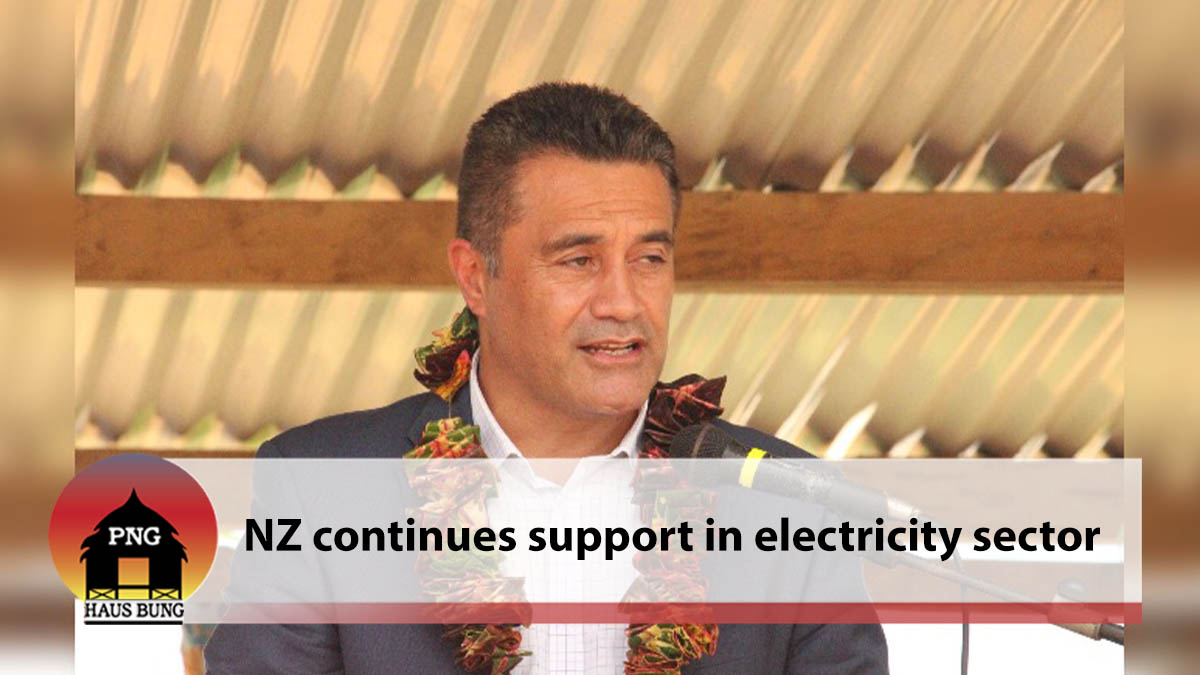
High Commissioner Taula, who spoke at the recent commissioning of one of these electricity projects- Hula Electrification Project in Central province, said this is one of the projects under the New Zealand government’s cooperation with the country.
“A key focus for New Zealand, both now and the future, is to try to extend the national grid (Electricity grid) into rural areas and to support renewable off- grid generation aimed at connecting households, businesses, schools and public buildings,” said the high commissioner.
“New Zealand has worked in this sector for many years. Over the last decade we’ve funded electrification projects to increase household connection in Enga, Oro, West New Britain and the Autonomous Region of Bougainville as well as Central province.”
“We’ve also provided policy development support, for example to draft PNG’s geothermal policy. New Zealand is also working with PEP to help to strengthen institutions such as PNG Power Limited and the National Energy Authority, which are both critical to success in the sector.”
He added that his country plans to work with the other partner donors under the PEP to further increase the number of connection right across the country because there is still a great deal of work to be done.
“I believe that this kind of partnership in bringing power to people’s homes and communities can transform lives. We see important value in education and health.”
The high commissioner concluded by saying that helping bring power to the houses so that children can do their studies at night time and making household tasks easier, and supporting families health and welfare, drives the purpose of this partnership in helping bring electricity service to the people. Picture: The New Zealand High Commissioner to PNG
Published on April 2, 2022
 CLUBS TO PREP FOR EASTER CUP CHALLENGE
In preparation for the inaugural Australian Football League (AFL) Easter Cup challenge, the Port Moresby AFL Association will be holding trial matches starting this Saturday 2nd April.
According to the association President Mr. Douglas Lai, the trials will get the players and clubs fine- tune themselves for the challenge up ahead next month.
“The trials will be for both women’s and men’s teams and eight regional teams will also be confirmed at the trials for the Easter Cup Challenge,” said the president.
This inaugural Easter Cup Challenge is sponsored by MoniPlus and will be named the MoniPlus Easter Cup Challenge.
There will be cash prices for winners, runners up and trophies for the best players in both divisions.
Meanwhile, Mr. Lai said the Easter challenge will run for two days using the state of origin like format with teams to play using the 12 aside format.
The Easter Cup challenge is confirmed for the 16th and 17th of April at the home of AFL in the city of Port Moresby, the Colts Oval at the Bisini sporting precinct.
The president further added that this cup challenge is the warm- up for the actual proper season which should start on the 23rd of April.
Published on March 31, 2022
 LOCAL GOVERNMENT AUTHORITIES MUST SUPPORT ELECTRIFICATION PROJECTS
The effort to reach 70% connectivity of homes to electricity in Papua New Guinea (PNG) will need the support of national, provincial and district government authorities to ensure that electricity projects sponsored by donors, are being delivered to the people.
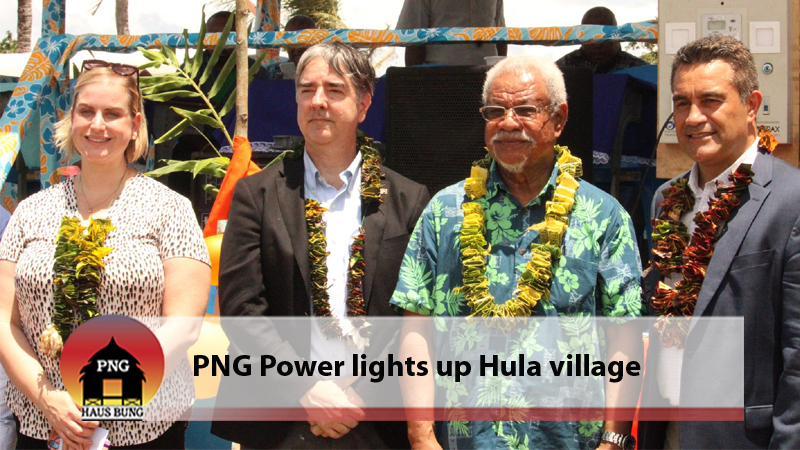
That was the message put forth by the PNG Power Limited (PPL) Acting General Manager Sustainable Business Development and Government Relations Mr. Mairawesi Pulayasi, when speaking to the people at the Commissioning of the Hula electrification project today in Rigo in the Central Province.
Mr. Pulayasi said PNG Power continues to work with donor partners like the New Zealand Government and other contractors to light up homes in the various projects initiated by the donors, but it can only do so much.
“What we have is evidence of a project that lightens lives and impacts our people, what does that mean to the provincial governments and the DDAs (District Development Authorities)?” asked the Acting General Manager.
Mr. Pulayasi said the pathway to electrifying PNG is a challenging one and PNG Power alone can’t do it without help.
“One of the biggest challenges we see and that has been recognized by our partners as well, is dealing with land issues. We sincerely invite the provincial governments and DDA's and we also are working with traditional chiefs to be champions in this.”
“Please provide your support to PNG Power by providing land, providing corridors so that electrification can be managed.”
He added that electricity is a vital service that improves the living standards of people and support business and economic growth be it in a district, a local level government area or nationally. Therefore, to achieve a better electricity coverage, there must be good collaboration between all parties involved.
The Commissioning today of the Hula Power project marked the start of better things to come for villagers from Galamaruku all the way to Hula.
This project is an initiative of the New Zealand government and is expected to benefit 30, 000 people at a cost of about K20million, which was supported and funded for by the people of New Zealand.
Published on March 30, 2022
 TEMPORARY GST CUT COULD RESULT IN FURTHER PRICE INCREASES
Although the intention of the government to ease the impacts of inflation on the people through these tough times may be reasonable through the temporary suspension of the Goods and Services Tax (GST), it could result in prices going further up for consumers going forward.
This was the warning from the Papua New Guinea (PNG) Institute of National Affairs (INA) Director Mr. Paul Barker when commenting on the recent move by state to suspend for six months the 10% GST on goods and services as a means of combat the current inflationary impacts brought about by the pandemic and partly by the current events internationally.
Barker said it’s best not to make changes at this time as it could result in further price increases after the six months.
“If you say you’re going to do it in six months and in that six months’ time if prices are still high and going on up, and then you put it (GST) on again, then prices will keep on going further up.”
“So, it would be much better not to do changes now just because there is an election coming, it would be better to remain consistent.”
Mr. Barker instead said the government should look at reducing the excise duty or tax charged on goods produced within the country, on fuel, of which he said should be a better option to lessen the inflationary impact currently experienced.
He explained that the high cost of fuel is directly affecting the prices of goods and services as well due to it being used for transportation of goods around the country.
This high cost is then passed on to everything.
“Now the fuel price has gone up, but it might as well come down again in six months’ time. So, it is easier to just administer the excise duty on fuel and to adjust quickly, then it is to adjust the GST.”
“So, it is probably better to reduce the inflationary effect by reducing the fuel excise duty for a period of time.”
Barker added that the prices are already going to be high and that’s already having the effects of discouraging the use of fuel, but by reducing the excise duty on fuel it can reduce the costs.
Published on March 30, 2022
 NSLS SEES GROWTH IN TEACHERS AND NURSES MEMBERSHIP
Nambawan Super Savings and Loans Society (NSLS) Limited is said to be the fastest growing savings and loans society in the country with a notable membership coming from the education department and medical fraternity.
According to the NSLS Chief Executive Officer (CEO) Mr. John Solok, the teachers make up about 35% which is around 10, 000 memberships and this makes up a third of the total membership base.
“In recent years we have seen a strong in-flow from the education department having a lot of teachers joining us and we would like to see that continue,” said Mr. Solok.
Mr Solok said the other notable membership is from the medical fraternity, especially from the nurses throughout the country.
“We also have a strong number coming from the nurses or generally the medical fraternity, which constitute about twenty per cent or around two hundred of our membership base,” added the CEO.
NSLS Board Chairman Mr. John Cholai added that the society with more than 30, 000 membership base, is the fastest growing savings and loans society that has 23 serving points throughout the country through the Nambawan Super Limited which is the number one supporter.
NSLS has branches located in Kokopo in East New Britain province, Kimbe in West New Britain province, Mt. Hagen in Western Highlands province, Lae in Morobe province and Alotau in the Milne Bay Province.
Published on March 28, 2022
 SAVINGS AND LOANS SOCIETY LAUNCHES TWO NEW PRODUCTS FOR MEMBERS
Members of Nambawan Super Savings and Loans Society (NSLS), now can find ease in saving to buy a new home or saving for future education costs, through two new products launched just recently.
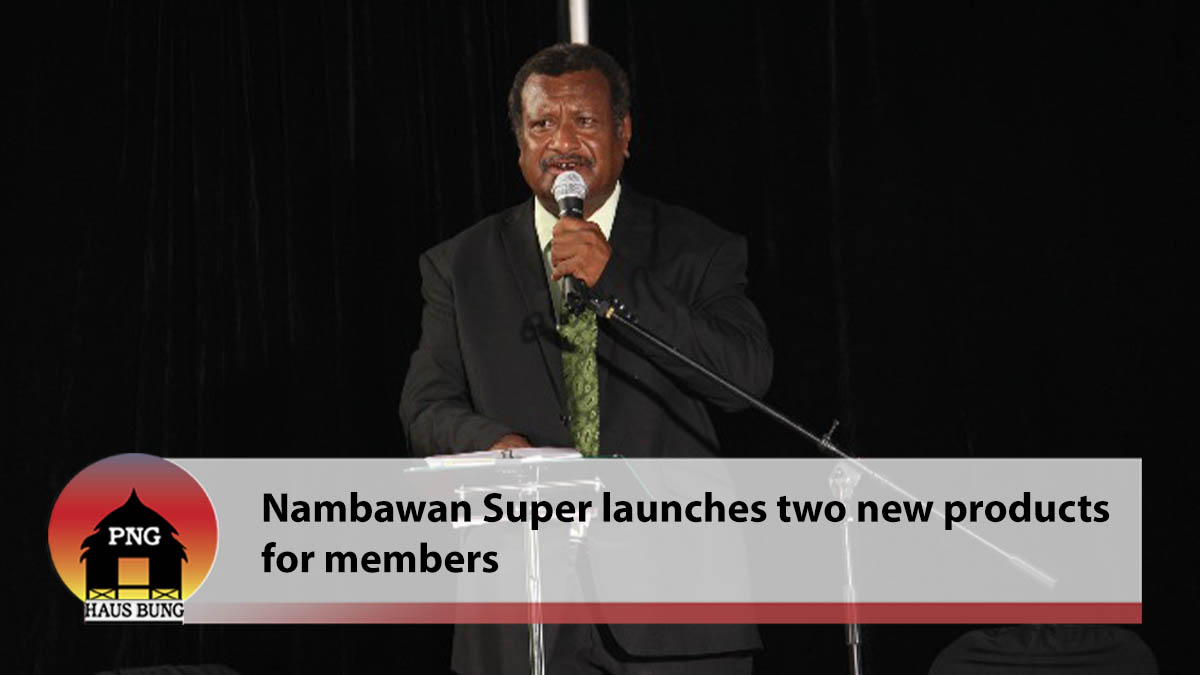
NSLS Chief Executive Officer (CEO) Mr. John Solok said these two new products are the Housing Saver and Tertiary Education Saver, which are aimed at better assisting members with housing and education needs of their children in the future.
The Housing Saver is a special purpose savings account designed to encourage members to save to cater for their minimum bank financing equity requirement or in case where they have land and require finance to build on.
The minimum fortnightly contribution is K300 and will have a 5% interest on the savings.
There will be no monthly account keeping fees and members will have access to these funds after three years. No withdrawal is allowed for any other purpose three years.
For the Tertiary Education Saver, will require a minimum fortnightly contribution of K100 and it has a 5 interest on saving annually with no monthly account keeping fees.
No withdrawal is allowed after two years for any other purposes. Mr. Solok also explained that in order to have a Tertiary Education Saver or Housing Saver, members must first open a General Saver Primary Account.
Meanwhile, the CEO also thanked the main superfund Nambawan Super Limited for the support given to the society since it was established, for it is such support that brought about such new financial savings products for members to benefit from.
"Nambawan Super view our role to ensure as many of their members are accessible to low cost finance, ensure as many of their members are not getting debt trapped with loan sharks and that we are accessible to Nambawan Super members nationwide if they do choose to sign up with us, " said the CEO.
The two new products were launched in a small but significant ceremony held on Friday 25th March at the NSLS head office in Port Moresby.
Published on March 27, 2022
 SUPPORT LOCAL FARMING TO COUNTER HIGH COST OF GOODS
The focus in these tough economic times currently experienced in the country brought about by the recent world events, should be to encourage agriculture and supporting the local fresh produce farmers in the rural areas.
That is the word from the Papua New Guinea Institute of National Affairs (PNG INA) Director Mr. Paul Barker when highlighting the importance of trying to mitigate the impact of the high-cost goods on the population.
Mr. Barker said people living in the main urban centers that depend on imported store goods are feeling the pinch of this.
This includes people in the informal economy, the people in the lower income and middle-income wage range.
This current economic situation will be a challenge for many, but Mr. Barker said for those in the farming sectors in the rural areas, they are likely not to be impacted too much by it and they can supply fresh produce, be it garden produce from the land or produce from the sea or rivers, to meet demands.
“The good thing in Papua New Guinea is that a large portion of the population actually have gardens and living in rural areas, and they are able to produce food. Many of them are able to produce cash crops and they are able to earn income and get better prices from their coffee, cocoa or oil palm and so on,” said Mr. Barker.
Barker said what the state can do is support farmers by getting their produce to the main markets in the urban areas by subsidizing the cost of transportation to make it convenient for the fresh produce to be supplied to the urban markets to compensate for the high cost of imported goods on consumers.
However, he added that for this to happen effectively the systems in place to give such assistance should be improved, so that funds allocated for this purpose are put to good use to make it happen.
That responsibility is on the national and the provincial authorities responsible to give such assistance.
Published on March 23, 2022
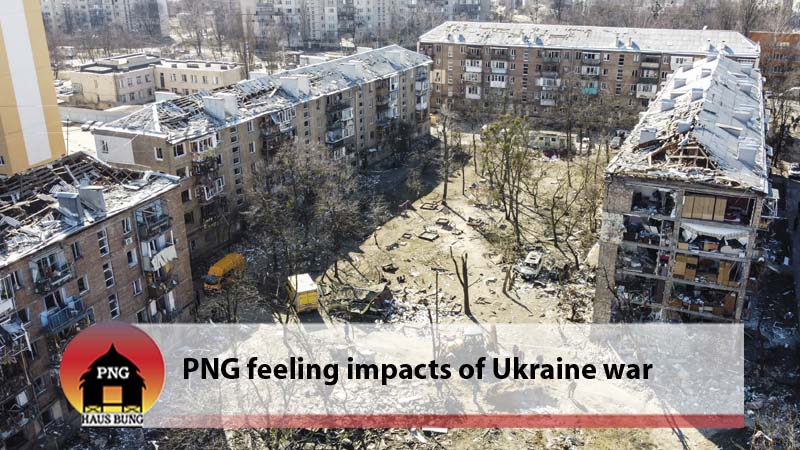 PANDEMIC AND WAR DUAL EFFECTS ON PNG ECONOMY
The effects from the pandemic and the recent War in Ukraine will have a dual effect on the small countries like Papua New Guinea (PNG) that both produce raw materials and import goods as well.
That’s according to the Director of the PNG Institute of National Affairs (INA) Paul Barker when commenting on the recent price increase in the country and the impacts of the war and the pandemic on the world market.
Barker explained that the impact on the world market comes from the two countries in conflict because both are also major producers and exporters of commodities like minerals, oil and gas, and agricultural commodities.
“It has resulted in major increases in commodity prices ranging from oil to gas through to nickel. The price of grain has gone up, so this is having an inflationary price effect on other agricultural crops as well.”
Barker said hopeful the conflict is resolved sometime soon because the longer it goes on, there will be longer term impact on the world markets and subsequently affecting smaller states like PNG.
However, on the benefit side Mr. Barker said PNG being a producer and exporter of some commodities, will stand to benefit particularly on the spot price and maybe longer-term sales price, where PNG can get a better return on producing and exporting.
But, on the other hand PNG is an importer of energy as well said Mr. Barker and it’s particularly fuel for vehicles, machinery, transport and shipping. PNG also is an importer of a range of grains and other food commodities and this will have an effect on living standards and the cost of doing business.
“This will have more impact on low income earners who spend more of their income on food and basic components for survival,” said Barker.
“That’s the real challenge because many households are struggling already with the existing cost of living without seeing the cost of living rising.”
Nevertheless, there are some measures the state could try to apply to mitigate this rise of cost brought about by the events in the world.
“The standard measure to try and restrain inflation via the central bank is to increase interest rate, but that’s not necessarily what the government would really want to do, especially because particularly energy is not an underlying inflation cause, it often goes up or down. "
“When you are using interest rates, it’s to try and restrain underlying longer term inflation, so dealing with shorter term inflation is a much harder thing,” explained Mr. Barker.
Another measure that Barker said the government could take is to improve access for local produce to reach the main domestic markets, to supply and meet the demand in tough economic times.
“One could take action to improve competition, improve the markets by making it easier for domestic produce to reach the markets. That certainly is always valuable to try and help the sustainable PNG fresh produce, not just to be able to reach Lae but to actually be able to reach Port Moresby. "
Mr. Barker further added that the state could subsidize the cost of shipping to encourage the supply of domestic produce around the country.
Barker said at times like these, the government should not only look at short terms measures but to look at the medium and long term measures as well and to use of the country’s own natural resources to try counter the economic impacts brought about by external factors.
Published on March 21, 2022
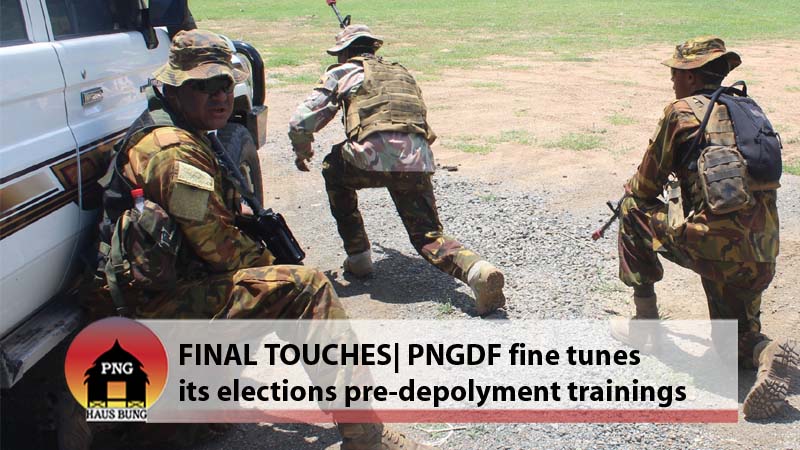 DAKI: WE ARE READY
The Papua New Guinea Defence Force is gearing up for the 2022 National General Election coming up in a couple of weeks’ time and is putting the final touches to the preparation of the personnel that will be deployed to support police provide security.
Defence Minister, Win Bakri Daki, was at the 1st Battalion headquarters at Taurama Barracks in Port Moresby this morning to witness the men and women going through the national election pre- deployment trainings in the different scenarios of what could happen during the polling and counting periods.
After witnessing the trainings, a satisfied Minister Daki says the defence force is ready and with the K100million funding given by the National Government, he is positive the defence force will deliver in providing security during the election period.
“We got our budget already, and its already in our account. The prime minister gave us a hundred million and the first fifty million is with us and another fifty million will be in one month time,” said the defence minister.
“We are training our boys and we are ready to go, as the minister for defence I am ready.”
Meanwhile, the National Election Pre- deployment training started off this week and should end next week.
The training takes the defence force personnel through the various possible scenarios that may occur during the election period and the proper ways to deal with these situations if they do arise.
The training was planned out and overseen by the defence force command with the support of partners like the Australia Defence Force (ADF) and members of the United States military.
Over 200 personnel from the First Royal Pacific Islands Regiment (1RPIR) and the Force Support Battalion (FSB) will be deployed the support police in elections operations in the highland’s region and some parts of the coastal areas considered to be hot spots.
The defence force will work under the Royal Papua New Guinea Constabulary (RPNGC) during the election as the police will be in charge of the whole election security operations in the country.
Published on March 18, 2022
 POLICE FUNDED AND READY FOR ELECTION
Police Minister William Onglo has confirmed that some funding for police for the 2022 National General Election security has been allocated to the Police Department and they stand ready to start the election operations.
According to the minister the cost of running the election from their perspective is about K194million and of that amount, the government has transferred K111million already to support police election operations.
“These are public funds, and it has to go through proper processes and procurement systems in order to run the elections,” said the police minister.
“Since last year our department has been briefed by the Commission, has gone through all the processes to undertake this election and we are ready now, and in the next couple of weeks we should be rolling out all requirements for logistics and support facilities we need for the elections.”
Minister Onglo added that the running of elections is always a difficult one, but he is sure that the Royal Papua New Guinea Constabulary (RPNGC) can manage it.
“So far, we have done very well in the last election, but this one we want to do it better,” said Minister Onglo.
Meanwhile, the minister said the aim of the National Government is to hold a safe, free, and fair 2022 National General Election and for this to happen will need the support of everyone.
He said police will be doing its bit like in every election that have come and gone, but the people themselves will ensure all goes well by behaving well during election and not cause trouble for other voters and election officials.
Published on March 17, 2022
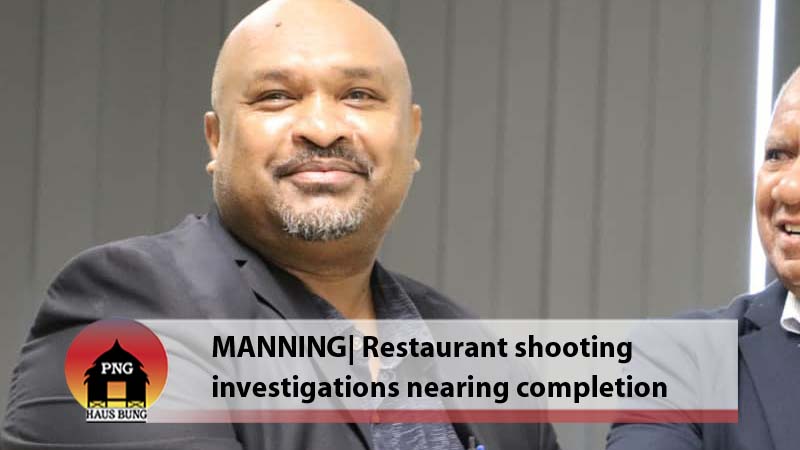 INVESTIGATION INTO RESTAURANT SHOOTING ALMOST COMPLETE
Police investigation into the recent shooting incident in a Port Moresby restaurant involving the Member for Moresby North- West Lohia Boe Samuel that resulted in the death of a man, is almost complete and police should make some arrests soon.
That is the word from Police Commissioner David Manning this morning at a press conference at the Police Headquarters in Port Moresby city.
Commissioner Manning was briefed regularly on a daily basis as to what the police investigators are doing since the shooting incident was first reported.
“We have established that a firearm was involved, we have established that someone was shot and killed as a result of a gunshot wound. We have established that the firearm does belong to a member of parliament and that he was there at that time when the incident occurred along with his associates,” said the police commissioner.
Manning said in the course of the investigation, police will be alleging that the member of parliament and his associates were responsible for that unfortunate incident and the investigation process will support that allegation.
“From what I have been brief on as of this morning, we have secured sufficient evidence to support that allegation that the member of parliament and his associates stand accused in this matter and I look forward to the completion of that investigation sometime today, and of course the necessary and appropriate action to be taken against those that we have evidence to support that allegation.”
Commissioner Manning later added that there is only one law in this country that covers every citizen and that it will apply to anyone regardless of status who breaks the law by committing a crime or crimes, and it’s the duty of police to enforce that law.
Published on March 16, 2022